Your Irrevocable Trust Isn't Stuck: Three States Made Decanting Easier
Can you change an irrevocable trust? Increasingly, yes — by pouring it into a new one. Kentucky and South Dakota rewired their decanting laws in 2026, and Florida's rebuild (SB 262, chapter 2025-159) has been in force since June 20, 2025. State by state: what changed, who can use it, and what decanting still cannot do.
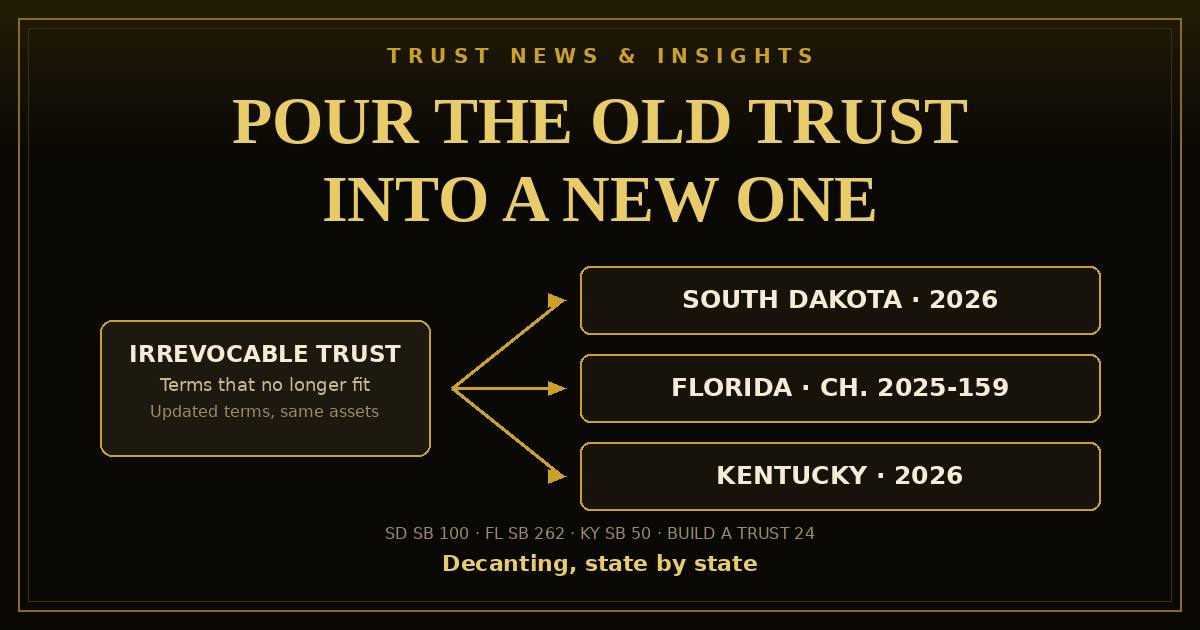
Trust decanting, explained: the pour
Decanting borrows its name from wine: just as wine is poured from an old bottle into a new one, a trustee with discretion over principal can pour an old trust into a new trust — the same assets, moved into a trust with updated terms. Families use it to fix drafting errors, modernize administrative provisions written for another era, respond to a beneficiary's changed circumstances, or move a trust's administration to a better jurisdiction — usually without asking a court.
It is not a free rewrite. Decanting statutes keep guardrails: the trustee generally cannot use the pour to add brand-new beneficiaries, reduce a beneficiary's vested right to a mandatory distribution, or reward themselves, and qualified beneficiaries get advance written notice (60 days under Florida's statute) with a chance to object. And it only exists where a state statute — or the trust's own terms — grants the power. Which is why the state-by-state map matters, and why three states' recent work rewrote it.
South Dakota — SB 100 (effective July 1, 2026): a tune-up, plus a tax power
South Dakota's annual Governor's Trust Task Force package passed the Legislature and was signed by the Governor in March 2026, taking effect July 1, 2026. South Dakota already had a decanting statute; SB 100's trust work is a precision tune-up with one genuinely new power:
- A clarification of the decanting statute itself (Section 2). SB 100 corrects cross-references in the decanting provisions and confirms that a trust termination belongs on the reformation side of the line the statute draws between reformations and decanting — housekeeping, but the kind that decides which power a trustee is actually exercising.
- The headline change is a tax fix (Section 1). New SDCL § 55-1-36.2 responds to IRS Chief Counsel Advice 202352018: an independent trustee, trust advisor, or trust protector may now use trust funds to pay or reimburse a grantor's income taxes attributable to a grantor trust, unless the trust instrument says otherwise — with no liability for exercising or declining the power. One limit to note: this reimbursement power applies only to trusts created on or after July 1, 2026, or moved into South Dakota on or after that date.
- Supporting cast: the probate code's advancement concept (a lifetime gift counted against an inheritance) extended to trusts, trustee compensation protected until a court orders it stopped, and a clarification that the attorney-client privilege in trust matters runs to the fiduciary.
Florida — SB 262, ch. 2025-159 (effective June 20, 2025): decant in place
Florida's entry is the 2025 law families have been living under through 2026 — CS/CS/SB 262, passed unanimously (Senate 36–0, House 114–0), approved by the Governor on June 20, 2025 as chapter 2025-159, and effective that day:
- Decant by modifying, not just by pouring (§ 736.04117). An authorized trustee may now exercise the decanting power by modifying the first trust's terms — reaching the same result as a second trust while skipping the asset retitling and the new EIN. The trustee who creates or funds a second trust is expressly not its settlor, removing a quirk that had discouraged trustees from decanting at all.
- Notice and limitations, clarified. The trustee's decanting notice is not a “trust disclosure document,” and a disclosure document does not start a limitations clock unless it is provided after the decanting takes effect. New subsection (12) confirms the statute reaches trusts governed by Florida law or administered in Florida — and the act's amendments are remedial, applying to trusts created before, on, or after its effective date. Existing Florida trusts included.
- Homestead protection (§ 736.151). Transferring homestead property into a community property trust is not a change of ownership — no property-tax reassessment on the transfer — and is treated as a transfer between spouses, with retroactive application. For couples who moved to Florida with an out-of-state community property trust, the companion definition changes (§ 736.1502) let them conform it to Florida law without a tax surprise.
Kentucky — SB 50 (effective July 15, 2026): a complete decanting act
Kentucky's SB 50 — signed by Governor Beshear as 2026 Kentucky Acts chapter 134 and effective July 15, 2026 — is the biggest of the three: an omnibus overhaul of the Commonwealth's trusts and estates law whose decanting piece is a complete statute, not a patch:
- A full Uniform Trust Decanting Act (Sections 87–114 of the Act), enacted as a new subchapter of Kentucky's trust code (KRS ch. 386B) and replacing the Commonwealth's short prior decanting statute (old KRS 386.175, repealed). Before SB 50, changing an irrevocable trust generally meant beneficiary consent — including for unborn beneficiaries — or a court petition.
- Two tiers of power. A fiduciary with expanded distribution discretion holds broad decanting authority; a fiduciary whose discretion is limited by an ascertainable standard (health, education, maintenance, support) holds a narrower one. Notice to beneficiaries is required before the power is exercised, and fiduciary duties govern the pour.
- Decanting into a special needs trust. The standout for families: a trustee may decant into a supplemental needs trust for a beneficiary with a disability even if the trustee lacked the discretion to make that distribution outright. A sudden inheritance or a beneficiary's changed circumstances no longer has to cost them needs-based benefits like Medicaid or SSI while the trust stays frozen in its old shape.
- It reaches existing trusts. The decanting act applies to trusts already in existence when it took effect, unless the trust's own terms say otherwise. The same bill also gave Kentucky a directed-trust act and its own qualified dispositions (asset-protection) trust act — a full modern trust code in one session.
What decanting still cannot do
Three honest limits. First, geography governs: a decanting statute helps only if it covers your trust — by its governing law or its principal place of administration — and your trustee actually holds the distribution discretion the statute builds on. A trust administered in a state without a modern statute may need a change of situs or a court order first. Second, the pour is not a beneficial-interest rewrite: notice rights, vested interests, and the same-beneficiaries guardrails are real constraints, and a beneficiary can object. Third, taxes ride along: decanting changes a trust's terms, not its history — generation-skipping status, grandfathered exemptions, and income-tax posture each need their own analysis before anyone pours.
Used inside those limits, decanting is the answer to the question this article started with: an irrevocable trust is a serious commitment, but in a growing list of states it is no longer a life sentence for its own drafting. Choosing the jurisdiction is a decision made at the drafting table — the Trust Builder takes a governing-law state for every trust it drafts, and the Trust Fund Playground lets you test a structure before you commit to one.
Read this before you rely on it
This is a news summary of three states' statutes, not a reading of your trust. Decanting turns on the interaction of a specific trust instrument with a specific state's statute — including notice mechanics, the trustee's exact distribution standard, and the tax posture of the particular trust — and the summaries above compress multi-section enactments (Kentucky's SB 50 runs to more than 140 sections) into their decanting highlights. Florida's provisions are described from chapter 2025-159 as enacted in 2025; South Dakota's from SB 100 as enacted for the July 1, 2026 effective date; Kentucky's from 2026 Acts chapter 134. Before exercising or relying on a decanting power, have the instrument and the current statute reviewed by a trust attorney in the state whose law governs the trust.
Get Trust News in Your Inbox
New rulings, trust law changes, and plain-language breakdowns from Build A Trust 24 — the same research that powers the builder. Free to read, free to receive.
Sources
- South Dakota Senate Bill 100 (2026), South Dakota Legislature; South Dakota Division of Banking, “New Trust Legislation” (SB 100 section summary)
- GPNA / South Dakota Trust Association, “South Dakota Trust Law Update — 2026 Edition,” September 2026
- Florida CS/CS/SB 262 (2025), ch. 2025-159, Laws of Florida (approved June 20, 2025); Florida Senate Committee on Judiciary, 2025 Summary of Legislation Passed — CS/CS/SB 262
- Kentucky Senate Bill 50 (2026), 2026 Ky. Acts ch. 134 (effective July 15, 2026); Uniform Trust Decanting Act, Sections 87–114 of the Act (new subchapter 13 of KRS ch. 386B)
- Louisville Bar Association, Bar Briefs (August 2026), “Kentucky Senate Bill 50: A Major Overhaul to KY Estate and Trust Law”