How to Become a Section 8 Landlord: The Model Behind the Video Everyone Is Sharing
A short video says affordable housing is wealth hiding in plain sight, because millions are waiting and the government stands behind the rent. The pitch is a masterclass — but the model underneath it is real, documented, and older than social media: the Section 8 landlord model. Here are the verified numbers, the actual steps, and the trust structure that holds the property for the long term.
The video's point — and the real numbers underneath it
A one-minute video by the creator HeavHaus is making the rounds with a simple argument: affordable housing is wealth hiding in plain sight, because the waiting list for it is enormous and the government stands behind the rent. The video itself teaches no steps — it ends by pointing viewers to a paid masterclass. But the model it is pointing at is real and fully documented: the federal Housing Choice Voucher program, still widely called Section 8, and the landlords who rent to the families it serves. This is that model, from the sources.
Start with the scale, because the scale is the opportunity. HUD describes the voucher program as the nation's largest rental assistance program, serving approximately 2.3 million households a year; HUD research puts the people housed at more than five million. Demand dwarfs that supply: only about one in four eligible households receives any federal rental assistance at all, waiting lists at local housing authorities commonly run for years, and Harvard's Joint Center for Housing Studies counted 8.5 million very-low-income renter households with severe housing problems that received no assistance in 2021. A round '7 million on the waiting list' figure circulates in videos like this one; HUD publishes no single national waiting-list count, so treat it as rhetoric. The documented picture needs no exaggeration: millions of families await a government-backed rent payment, and there are not enough homes offered to them.
How the voucher money actually flows
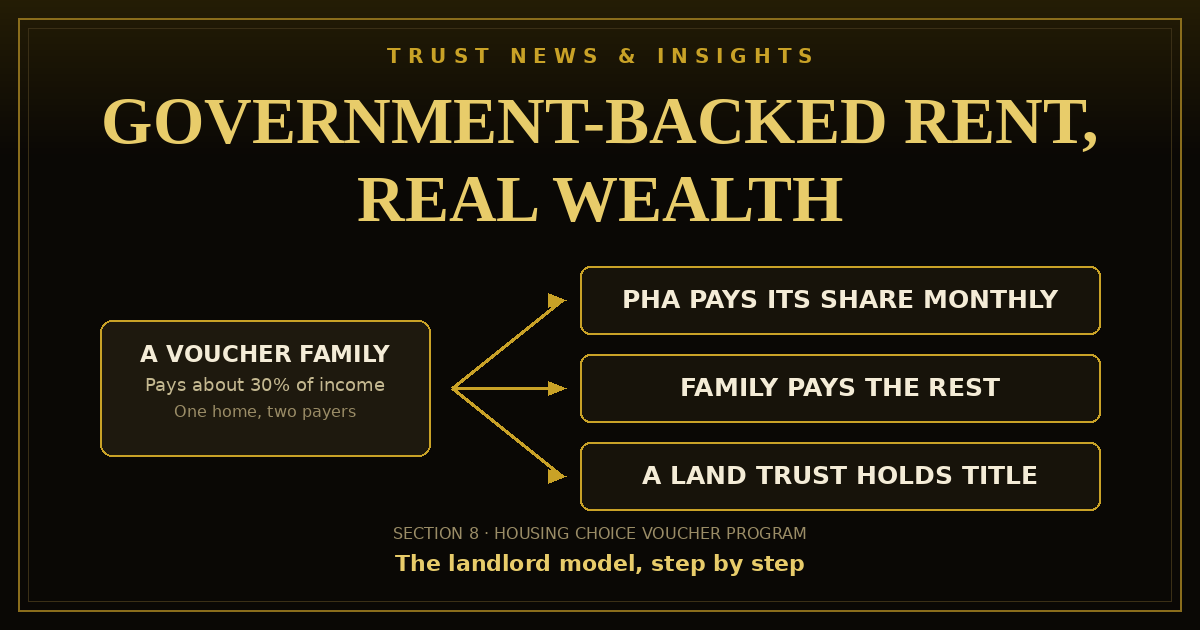
A family with a voucher shops the private market for a home whose owner will participate. The family pays roughly 30% of its adjusted income toward rent and utilities. The local public housing agency — the PHA — pays the rest of the approved rent directly to the landlord, every month, under a Housing Assistance Payments (HAP) contract between the agency and the owner. That split is the whole engine: your second payer is a government agency under contract.
Two caps keep it disciplined. The rent cannot exceed the agency's payment standard, set from HUD's Fair Market Rents for the area (generally 90–110% of that figure), and the specific rent must pass a rent reasonableness test against similar unassisted homes nearby. And before any payment flows, the home must pass the agency's inspection for health and safety — heat, hot water, safe wiring, intact windows and locks, no lead-paint hazards — with re-inspections on the agency's schedule. The landlord still screens applicants with their own lawful criteria, signs the lease, and enforces it; the agency verifies eligibility, not tenant quality.
The steps: how to become a Section 8 landlord, in order
No federal license exists for this. What exists is a sequence, and doing it out of order is where beginners lose months:
- 1. Form the structure first. Decide who owns the home before you buy it. For most small operators that means a holding entity (often an LLC) to run operations, with the property itself placed in a land trust — the stack taught in this site's Real Estate & Land Trusts track. Retrofitting ownership after closing costs more than setting it up first.
- 2. Get funded. Line up the purchase money through ordinary channels: a conventional investment-property loan; a DSCR loan underwritten on the property's rent rather than your personal income; FHA financing if you will live in one unit of a small multifamily home; or the business credit your purchasing entity has built — the fund-it-with-your-business route. Lenders lend on the deal and the documents: a clean entity with its own accounts gets further than a personal scramble.
- 3. Buy where the payment standard works. Compare the agency's published payment standard for the bedroom count against local prices. The model works where a sound home's rent fits under the standard with room left for taxes, insurance, and maintenance — not in every zip code.
- 4. Make the home inspection-ready. The inspection list is public. Passing the first time protects the whole timeline, because assistance payments cannot begin until the home passes.
- 5. List the home and choose your tenant. Advertise the unit (many agencies run landlord listing portals), screen applicants with the same lawful criteria you use for any tenant, and complete the agency's Request for Tenancy Approval together with the voucher holder you select.
- 6. Sign the two agreements. Your lease with the tenant, including HUD's tenancy addendum — and the HAP contract with the agency. The agency's share then arrives monthly by direct deposit; the family pays its share to you.
- 7. Hold, inside the structure, for the long term. Keep the home maintained, pass re-inspections, and let time do the compounding: steady rent, a tenant with every reason to stay, and equity building as the loan amortizes. This is a hold strategy measured in years — which is exactly why the ownership structure in Step 1 matters.
Where Build A Trust fits: the holding stack
A rental home is three things at once: an asset, a liability magnet, and a future estate problem. The stack this site teaches gives each job its own layer. The land trust holds title — ownership stays private, and the property can pass to your beneficiaries without probate. The holding entity signs leases and collects rent, keeping the operational risk in its own box. The family trust holds the beneficial interests above both, so rents flow up through the same waterfall the Trust Fund Playground lets you model before you build the real thing in the Trust Builder. The site's Land Trusts section walks the real-estate version of this stack step by step.
The stack also makes Step 2 honest. An entity that owns assets, keeps its own books, and holds title through a trust is a more credible borrower than an individual buying in their own name — that is the true part of 'fund it with your business.'
The long game, in honest numbers
Illustration only — scenario arithmetic, not a promise. Take one sound home bought for $150,000 with $30,000 down, rented at $1,400 a month within the agency's payment standard, the agency covering about $1,000 of that rent. Assume values rise a modest 3% a year and a 30-year loan at 7% amortizes on schedule. After 15 years the home would be worth roughly $234,000, the loan balance would be down near $89,000, and the equity would approach $145,000 — before counting fifteen years of monthly cash flow after expenses. Repeat that pattern across a handful of homes over two decades and the seven-figure net-worth conversation stops being fantasy. That is the entire truthful content of the 'made millionaires' line: ordinary homes, backed rent, and a very long clock.
The same arithmetic can disappoint. Major repairs, a long vacancy, tax and insurance increases, or simply overpaying at purchase will erase it. The model rewards operators who buy right and maintain — not spectators, and not anyone in a hurry.
Read this before you rely on it
Three limits the videos skip. First, the caps are real: rent above the payment standard, or judged unreasonable against comparable homes, will not be approved however strong demand is — the agency's numbers, not the market's hopes, set your ceiling. Second, local rules run the program: some 2,200 housing authorities administer vouchers, payment timeliness and paperwork vary by agency, and a growing list of states and cities ban source-of-income discrimination — know your jurisdiction's rules before you list, and confirm every figure here with your local PHA. Third, one claim in the video needs a footnote: 'the government will fund the entire project' describes affordable-housing development programs — tax credits and grants for building senior and workforce housing — a different and much larger undertaking than the tenant-based landlord model taught in this article. No program writes a private landlord a check for a whole purchase. Finally: inspections, approvals, and amortization all run on a clock of years. Anyone selling you a shortcut around that clock is selling the shortcut, not the model.
Get Trust News in Your Inbox
New rulings, trust law changes, and plain-language breakdowns from Build A Trust 24 — the same research that powers the builder. Free to read, free to receive.
Sources
- U.S. Department of Housing and Urban Development (HUD) — Housing Choice Voucher program and landlord resources, hud.gov (tenant share, HAP contract, inspection, rent reasonableness)
- HUD User / HUD Office of Policy Development & Research, 'New Research on Estimating Success Rates for the Housing Choice Voucher Program' (July 2025) — the nation's largest rental assistance program, serving approximately 2.3 million households annually
- Center on Budget and Policy Priorities, Policy Basics: The Housing Choice Voucher Program — households pay about 30% of income; payment standards are based on HUD Fair Market Rents
- HUD Evidence Matters landlord research, reported by the National Multifamily Housing Council (2019) — the voucher program houses more than five million people; roughly three of four eligible households receive no assistance
- Harvard Joint Center for Housing Studies (2025) — 8.5 million very-low-income renter households with severe housing problems received no federal housing assistance in 2021
- HeavHaus, 'How To Use Government Funding To Get Into Real Estate,' Facebook reel (October 28, 2026) — the video this breakdown examines; its waiting-list figure and funding claims are addressed in the article