IRS Lets a Grandfathered Trust Split in Three — With No GST, Income, or Gift Tax
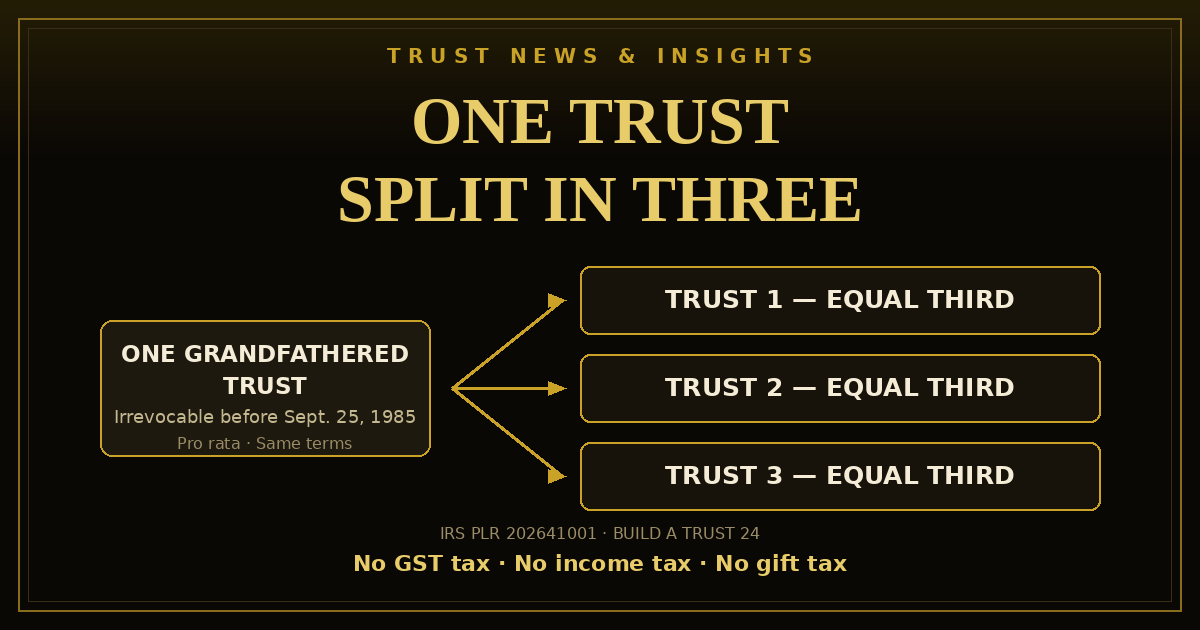
In PLR 202641001, released October 9, 2026, the IRS approved a trustee's plan to divide one long-standing family trust into three equal trusts — and ruled the division triggers no generation-skipping transfer tax, no income tax, and no gift tax.
What happened
The trust at the center of the ruling is an old one: it became irrevocable before September 25, 1985, and nothing was added to it after that date. That makes it “grandfathered” — exempt from the generation-skipping transfer (GST) tax that applies to later trusts.
Under the trust's terms, after the death of the settlor's child, the trust must pay all of its income to the grandchild, and the trustee may also distribute principal to any of the settlor's issue for their maintenance, support, and education.
The problem was a familiar one for legacy family trusts: the three great-grandchildren had developed different investment goals and different distribution priorities, yet all of their interests sat in a single pool of assets. The trustee proposed dividing the trust into three equal trusts — one for each great-grandchild and that great-grandchild's issue — funded pro rata under a state statute that permits a trust division after notice to the qualified beneficiaries. Each new trust would otherwise keep the original trust's terms, and the beneficiaries' interests would stay the same.
What the IRS approved
The IRS ruled in the trustee's favor on every point:
- GST grandfathered status preserved. The division does not shift any beneficial interest to a beneficiary in a lower generation, and it does not extend the time for vesting of any beneficial interest beyond the period in the original trust — the two conditions the GST regulation (Reg. § 26.2601-1(b)(4)(i)(D)) requires. The regulation's own Example 5 approves a similar split.
- No income, gain, or loss. Relying on Rev. Rul. 56-437 and Rev. Rul. 69-486, the IRS concluded a pro rata division of trust assets is not a sale or exchange, so the division results in no recognition of income, gain, or loss under §§ 61, 661, 662, and 1001.
- No gift tax. The beneficiaries' interests have the same value before and after the division, so the division is not a taxable gift.
- Basis and holding periods carry over. The divided assets keep their carryover basis and holding periods under §§ 1015 and 1223(2).
- Three separate taxpayers. Because no contributions were made to the trust after March 1, 1984, the § 643(f) multiple-trust rule did not apply, and each resulting trust is a separate taxpayer for income tax purposes.
Why it matters for families with older trusts
Many families are administering trusts drafted a generation or two ago, where one trust now serves several branches of the family who no longer want the same things from it. This ruling confirms the IRS's consistent approach: a carefully structured division of a grandfathered trust can give each branch its own trust without surrendering the trust's GST-exempt status and without a tax bill for making the change.
Three features of the plan carried the result, and they are the checklist any trustee should take from it: (i) the division was pro rata — each new trust received its proportionate share; (ii) beneficial interests stayed substantially the same — same terms, same value, no interest shifted to a lower generation and no vesting period extended; and (iii) the division was valid under state law, carried out under a state division statute after notice to the qualified beneficiaries.
One caution from the ruling itself: the GST regulation's safe harbor protects GST status only. Gift tax and income tax each needed — and received — their own separate analysis. A division that is safe for one tax is not automatically safe for the others.
Read this before you rely on it
A private letter ruling is the IRS's answer to one taxpayer about one set of facts. Under § 6110(k)(3), PLR 202641001 binds only the taxpayer who requested it and may not be used or cited as precedent. It is a dependable model of how the IRS has approached these divisions — it is not a guarantee for any other trust. A trustee considering a similar division should expect to document the same features (pro rata funding, unchanged interests, state-law authority) and to get advice on their own facts, or request their own ruling.
Get Trust News in Your Inbox
New rulings, trust law changes, and plain-language breakdowns from Build A Trust 24 — the same research that powers the builder. Free to read, free to receive.
Sources
- IRS Private Letter Ruling 202641001, released October 9, 2026
- Legal 500, “Dividing A Grandfathered Trust Without Tax Cost: Lessons From PLR 202641001,” October 27, 2026
- Wealth Strategies Journal Daily Update, October 13, 2026 (PLR 202641001 summary, IRS.gov)