The IRS Keeps Forgiving Missed Trust Elections
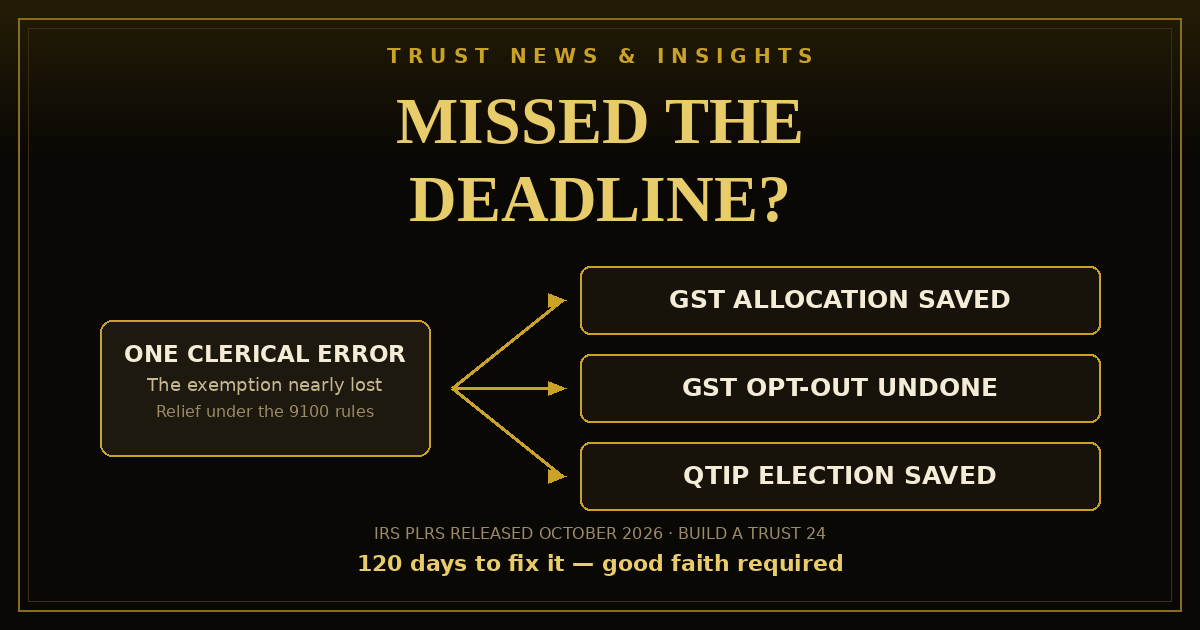
Four IRS rulings released in October 2026 do the same thing four different ways: forgive a trust election that was missed, botched, or filed backwards — and hand the family a deadline to fix it. Here is the pattern, ruling by ruling.
What happened: four trusts, one wrong number
Call it what families call it when they find it in an old file: IRS forgiveness for a missed trust election. In October 2026 the IRS released a cluster of private letter rulings — PLRs 202643003, 202643004, and 202643005 on October 23, and PLR 202640005 on October 2 — and every one of them forgives an election that went wrong on paper and gives the taxpayer a window to fix it.
The first two rulings are companions, one for each spouse of the same couple. The couple created four trusts, one for each of their four children and the children's descendants, and funded them with real estate, stock, and other assets. Their gift tax returns (Form 709) reported the gifts correctly as indirect skips. But a clerical error understated the amount on Schedule D's automatic allocation line, so only part of the couple's generation-skipping transfer (GST) exemption actually attached to the trusts. Nobody noticed for years — not until both spouses had died and a new firm, preparing the estate tax return (Form 706), found the mistake.
The third GST ruling is the mirror-image mistake. A donor funded an irrevocable trust for his descendants, and he and his wife split the gift on their returns. Their accountant then mistakenly filed the election to opt out of the automatic GST allocation — turning the exemption off entirely, the opposite of what the couple intended. A new accountant and the couple's attorney caught the error the following year; importantly, no distributions had been made from the trust in the meantime.
What the IRS approved
In all three GST rulings, the IRS applied the same regulation — § 26.2642-7, the GST regulation that carries out the relief authority in § 2642(g) of the Code — and reached the same result:
- PLRs 202643003 and 202643004 (the four trusts). The requirements of § 26.2642-7 were satisfied. The executors received an extension of 120 days from the date of the ruling letter to allocate the GST exemption, effective as of the original transfer dates and using the values as determined for gift tax purposes — a complete missed GST exemption allocation fix, made on an amended Form 709 with a copy of the ruling attached.
- PLR 202640005 (the mistaken opt-out). The wife received the same 120-day extension to allocate her GST exemption to her half of the transfer to the trust. The mistaken § 2632(c)(5) opt-out did not permanently cost the family the exemption.
- The pattern in one line: the exemption followed the family's proven intent, not the preparer's typo — because the families could show they always meant to allocate it.
The QTIP ruling: a marital trust left off the form
PLR 202643005 is a different election with the same ending. A husband's revocable trust became irrevocable at his death. His estate was smaller than the federal estate tax exclusion but larger than his state's smaller exclusion, so the plan was to fund a marital trust with the amount above the state line and defer both taxes until his wife's death — a plan that only works if the executor makes a QTIP election for that trust on Schedule M of the estate tax return.
The tax professional who prepared the Form 706 simply left the marital trust off Schedule M. The election was never made. The professional later filed a supplemental Form 706 listing the trust as QTIP property, and the estate asked the IRS for more time. The IRS granted it: an extension running to the date of that supplemental return, so the QTIP election counts.
The legal door was different — §§ 301.9100-1 and 301.9100-3, the general election-relief regulations (the “9100” rules) — and one factor did the heavy lifting: under § 301.9100-3, a taxpayer who reasonably relied on a qualified tax professional who failed to make the election is treated as having acted reasonably and in good faith.
9100 relief, explained: the two questions the IRS asks
Strip the citations away and every one of these rulings turns on two questions. First: did the taxpayer act reasonably and in good faith? The regulations list what counts — a genuine intent to make the election on time, reasonable reliance on a qualified tax professional, events beyond the taxpayer's control, and honest lack of awareness despite reasonable diligence. Second: will relief prejudice the interests of the government? The IRS looks for hindsight games — asking only after the assets performed well — and for delay designed to run out the clock, or a taxable event in between that the late election would now rewrite.
That is why the details in these stories matter. In each ruling the error was a preparer's, the intent was documented, the mistake was found by a new professional reviewing the file, and — in the opt-out case — nothing had been distributed from the trust in the meantime. A missed election discovered early and documented honestly is a strong relief candidate; a “mistake” discovered after the numbers moved is not.
One honest cost note: this relief is not a form you file. Each family had to request a private letter ruling, and the requests in this cluster were filed in December 2025 and February 2026 for letters issued in June and July 2026 — roughly six to eight months of waiting, plus an IRS user fee and professional fees. The cheap version of this fix is catching the error before the return is filed.
What this means if you find a missed election
If a review of an old Form 709 or Form 706 turns up a missed GST allocation, a stray opt-out, or a QTIP election that was never made, these rulings are the map: do not assume the damage is permanent, and do not try to quietly amend your way out of it either. The relief path runs through a ruling request built on evidence of intent — the trust instrument, the original returns, and the preparer's file. Document what was intended, act promptly once the error is found, and expect the IRS to ask the same two questions it asked in October.
Setting up a trust of your own — or reviewing one your family already runs? The elections live and die on the paperwork, which is why the Trust Builder drafts the complete indenture package and the Trust Fund Playground lets you run a structure before you form it.
Read this before you rely on it
A private letter ruling is the IRS's answer to one taxpayer about one set of facts. Under § 6110(k)(3), PLRs 202643003, 202643004, 202643005, and 202640005 bind only the taxpayers who requested them and may not be used or cited as precedent — PLR 202643005 says so in its own text. These rulings show how the IRS applies its relief regulations to honest, documented mistakes; they are not a guarantee for any other trust or estate. Relief is fact-specific, discretionary, and requested ruling by ruling. If you are looking at a missed election in your own family's filings, get advice on your own facts from a tax professional before the trail gets any colder.
Get Trust News in Your Inbox
New rulings, trust law changes, and plain-language breakdowns from Build A Trust 24 — the same research that powers the builder. Free to read, free to receive.
Sources
- IRS Private Letter Ruling 202643003, released October 23, 2026 (IRS.gov)
- IRS Private Letter Ruling 202643004, released October 23, 2026 (IRS.gov)
- IRS Private Letter Ruling 202643005, released October 23, 2026 (IRS.gov)
- IRS Private Letter Ruling 202640005, released October 2, 2026 (IRS.gov)
- Generation-Skipping Transfer Tax Regulations § 26.2642-7; Procedure and Administration Regulations §§ 301.9100-1 and 301.9100-3