How to Start a Non-Profit — and the Tax Benefits That Come With It
A non-profit is built in two halves: your state creates the organization, and the IRS decides whether it is tax-exempt. Here are the formation steps in order, the tax benefits a 501(c)(3) actually receives, and how a non-profit fits beside a family trust.
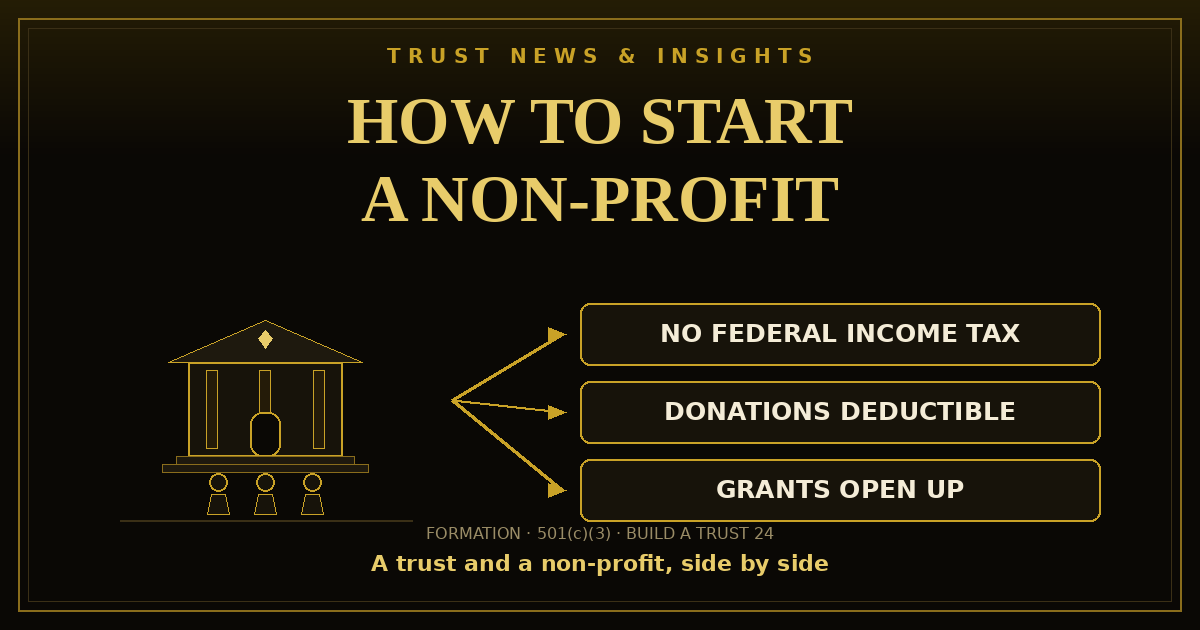
First, what a non-profit is — and is not
A non-profit is an organization with a mission instead of owners. It is usually formed as a nonprofit corporation under state law: it has directors instead of shareholders, its money must be spent on its stated purpose, and no part of its earnings may be diverted to a founder, director, or any other private individual — a rule the IRS calls no private inurement. If the organization ever closes, its remaining assets must go to another exempt purpose, not into anyone's pocket.
Here is the distinction most people miss, and the heart of 501(c)(3) explained plainly: forming a nonprofit corporation with your state does not by itself make anything tax-exempt. State incorporation creates the organization. Federal tax exemption is a second, separate step — an application to the IRS under section 501(c)(3) of the tax code, the category covering organizations operated for charitable, religious, educational, scientific, or literary purposes, among others listed in the statute. Most of the tax benefits people associate with non-profits flow from that federal determination, not from the state filing.
How to start a non-profit, step by step
If you are researching how to start a nonprofit, the order matters — each step below unlocks the next one:
- 1. Choose the purpose and the name. Write the mission in one or two sentences, then check the name against your state's business records so it is available and not confusingly close to an existing organization.
- 2. Incorporate with the state. File articles of incorporation for a nonprofit corporation with your state's corporations office and pay the state filing fee. For an organization that will seek 501(c)(3) status, the IRS expects the articles to limit the organization's purposes to exempt ones and to dedicate its assets to exempt purposes if it ever dissolves — put that language in at formation, not later.
- 3. Get an EIN. Apply to the IRS for an Employer Identification Number (Form SS-4; the online application is free). The non-profit needs its own EIN even if it has no employees — it is the organization's tax ID for its bank account and filings.
- 4. Set up the board and bylaws. Name the initial directors (many states require at least three), adopt bylaws covering meetings, officers, and conflicts of interest, hold the first organizational meeting, and keep minutes. This paper trail is what makes the organization real in the eyes of banks, donors, and the IRS.
- 5. Apply to the IRS for tax-exempt status. File Form 1023 for the full application, or Form 1023-EZ if the organization is small enough to be eligible — generally, projected gross receipts of $50,000 or less per year in its first three years and total assets of $250,000 or less. A user fee applies (as of this writing, $600 for Form 1023 and $275 for the 1023-EZ). Only after the IRS issues a determination letter is the organization a recognized 501(c)(3).
- 6. Finish the state layer. Depending on the state, that can mean a separate application for state income-tax exemption, applying for sales- or property-tax exemptions where the state offers them, and — in the many states that require it — registering for charitable solicitation before asking the public for donations.
- 7. Open the books. Open a bank account in the organization's name and EIN, set up bookkeeping that tracks restricted and unrestricted funds separately, and calendar the annual filings described below. Formation is a day; administration is every year after.
The tax benefits, plainly
The nonprofit tax benefits are real, but they are specific — each one attaches to the 501(c)(3) determination and each one has a boundary. The main ones:
| Benefit | What it means |
|---|---|
| Federal income-tax exemption | Under § 501(a), a recognized 501(c)(3) pays no federal income tax on income related to its exempt purpose. |
| Deductible donations | Contributions to a 501(c)(3) are deductible for donors under § 170 — for donors who itemize deductions — which makes fundraising materially easier. |
| Grant eligibility | Most foundation and government grant programs will only fund recognized 501(c)(3) organizations. |
| State tax exemptions | Many states exempt 501(c)(3)s from state income or franchise tax, and some extend sales- or property-tax exemptions — these vary widely by state and usually require their own applications. |
And the boundary every founder should know before the first dollar arrives: UBIT. Income from a trade or business that the organization carries on regularly and that is not substantially related to its exempt purpose is unrelated business income, and it is taxable (§§ 511–514) even for a 501(c)(3). Alongside UBIT sit the bright lines of the exemption itself: no private inurement, no more than an insubstantial amount of lobbying, and — for 501(c)(3)s — no participation in political campaigns for or against candidates.
Keeping it: the compliance that protects the exemption
Tax-exempt status is not a one-time trophy; it is maintained annually. Most 501(c)(3)s must file a Form 990 series return with the IRS every year (the full 990, the 990-EZ, or the 990-N e-postcard for the smallest organizations). An organization that fails to file for three consecutive years has its exemption automatically revoked under § 6033(j) — and getting it back means applying again. The 990s are also public documents, which is part of the design: donors can read them.
One structural test is worth knowing at the planning stage: a public charity must normally show a broad base of public support — gifts and grants from many sources rather than funding from a single family — or meet another public-support category. An organization funded and controlled by one family is generally classified as a private foundation, which carries stricter rules on investments, payouts, and self-dealing. Which side of that line a new organization lands on shapes its paperwork for its entire life.
Non-profit vs trust — and why families run both
The nonprofit vs trust question comes up constantly in this audience, because the two vehicles solve different problems. A trust is a private arrangement — a grantor hands property to a trustee to hold for named beneficiaries. It needs no IRS permission to exist, it stays private, and it is the tool for control, succession, and keeping family assets organized; it is also, ordinarily, a taxpayer itself, not a tax-exempt one. A non-profit is a public-facing organization: no owners, deductible donations, grant access — and in exchange, public filings, a board, and compliance that never stops.
Run together, the pairing is powerful, and it is the same structure this site teaches in its Trust & Businesses material: the family trust holds and organizes the private side, while the non-profit carries the mission. A trust can name a 501(c)(3) as one of its beneficiaries — so family wealth can flow to the cause, on the trust's terms and timetable — and charitable structures in the trust library, like the Charitable Remainder Trust, exist precisely to split benefits between family beneficiaries and charity. The trust is the vault and the steering wheel; the non-profit is the public engine.
Planning a structure like that? Build the trust side in the Trust Builder, study how entities connect in Trust Funds & Businesses, and watch for the interactive Trust Fund Playground coming to this site — you will be able to snap a non-profit tile into a structure next to a business and run the whole thing before you form anything.
Read this before you rely on it
This article is a general explainer, not a ruling and not advice about your organization. Nonprofit corporation law, charitable-solicitation registration, and state tax exemptions are set state by state and differ in fees, forms, and deadlines; federal exemption turns on the organization's actual purposes and activities, not just its paperwork. The fee and threshold figures above are the IRS's published amounts as of this writing and can change. Before incorporating or filing Form 1023 or 1023-EZ, have the articles, bylaws, and application reviewed by a lawyer or CPA who works with exempt organizations in your state.
Get Trust News in Your Inbox
New rulings, trust law changes, and plain-language breakdowns from Build A Trust 24 — the same research that powers the builder. Free to read, free to receive.
Sources
- IRS, “Apply for tax-exempt status” and “Exemption requirements — 501(c)(3) organizations,” IRS.gov
- IRS Publication 557, Tax-Exempt Status for Your Organization
- IRS Forms 1023 and 1023-EZ and their instructions, IRS.gov
- Internal Revenue Code §§ 170, 501(c)(3), 511–514, 6033(j)